
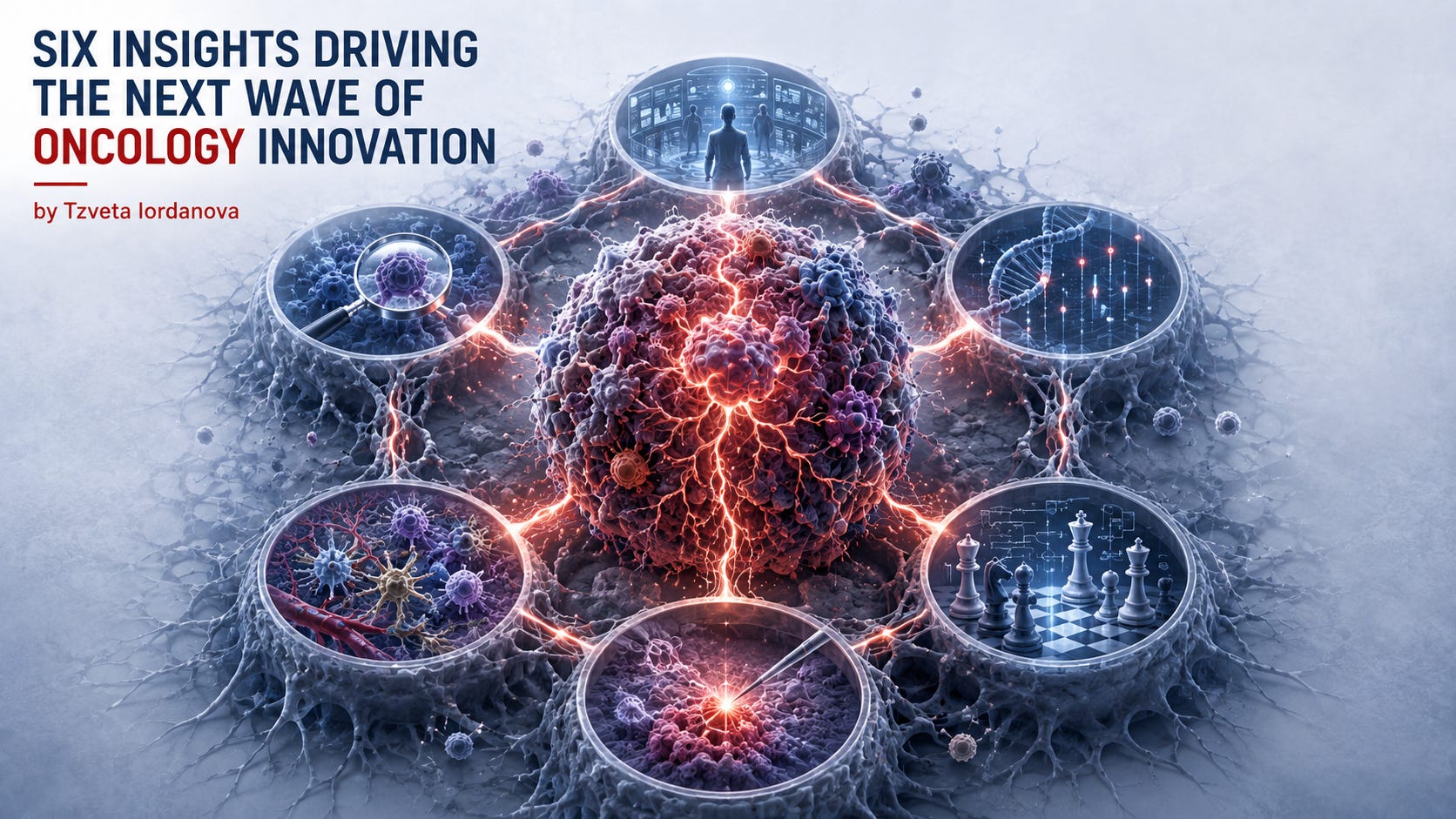
Modern oncology is rich in tools but constrained by models. When cancer behaves as a complex, adaptive system, linear approaches built around isolated interventions predictably fall short.
Below are six core insights reshaping oncology, and why the next decade will look very different from the last.
1. Single agents fail because cancer is multi-pathway and adaptive
Cancer rarely depends on a single pathway, mutation, or signal. It survives through:
redundancy (backup survival routes),
feedback loops (systems that re-stabilize under pressure),
heterogeneity (different regions behaving differently),
evolution under therapy (resistant clones expanding).
This makes single-agent approaches inherently insufficient. Short-term responses are common; durable control is not.
Key Insight: Outcomes are determined less by what is targeted than by how the system responds over time.
Innovation implication: Progress shifts from “stronger drugs” toward multi-axis strategies designed to anticipate adaptation across immune, metabolic, and microenvironmental axes - rather than reacting to resistance after it emerges.
2. Diagnosis is an early biological intervention, not a neutral observation
Imaging, biopsy, and biomarker testing can alter the biology they aim to describe. Diagnosis is not a passive prelude to treatment; it is already part of the intervention timeline.
Imaging
CT and PET involve ionizing radiation.
Repeated imaging represents cumulative biological stress and DNA damage, not free information.
Biopsy
Biopsy is necessary, but it can trigger:
wound-healing responses and inflammation,
immune–stromal remodeling, including recruitment and activation of suppressive myeloid programs,
microenvironmental changes that may favor invasion or escape in some contexts.
In some cancers, delays of more than ~53 days between biopsy and definitive treatment have been associated with higher metastatic risk.
Key Insight: Diagnostic access introduces biological risk and must be paired with countermeasures.
Innovation implication: Innovation shifts from optimizing individual tests to designing integrated diagnostic–interventional pathways—evaluated for biological impact (tumor biology, immune function, inflammation, treatment readiness), not just informational value.
3. Biomarkers are helpful - but not guarantees
Biomarkers (PD-1/PD-L1, MSI, TMB, ctDNA, etc.) are signals, not certainties. They should inform dynamic, closed-loop strategies rather than act as fixed truths.
Results mislead because of:
Heterogeneity: Hot and cold regions coexist within the same tumor, each governed by different biology and requiring different interventions.
Sampling bias: A single biopsy rarely represents the full tumor ecosystem. Samples are typically taken from the tumor core, while biologically relevant signals e.g., PD-L1 expression are often enriched at invasive margins—explaining why some patients respond despite unfavorable biomarker profiles.
Adaptive resistance: “Positive” signals may reflect active defense mechanisms rather than therapeutic vulnerability, explaining why some patients do not respond despite favorable biomarker profiles.
Override biology: Immune suppression, metabolic constraints, stromal barriers, and microbiome effects can block response to most novel drugs despite favorable biomarkers.
Key Insight: Biomarkers should function as decision support within a broader strategy, designed at the micro-ecosystem level rather than the patient-average level.
Innovation implication: Innovation shifts from using biomarkers to select patients or therapies to using them to steer adaptive, micro-ecosystem–level strategies over time.
4. The tumor microenvironment decides whether drugs can work
“Cold vs hot” (immune-excluded vs immune-infiltrated) often predicts immunotherapy success as much as - or more than - the drug choice.
Vascular access, stromal barriers, metabolic constraints, and immune suppression can render even advanced therapies ineffective.
Key Insight: Response is determined by the microenvironment and where and how therapy is delivered, not only by what is delivered.
Innovation implication: Enabling response often requires modifying the microenvironment. Local therapies such as PEF, cryoablation, or radiation can convert non-responsive regions into immunologically active ones.
5. Strategy matters more than ingredients
The same tools, applied differently, can produce radically different outcomes. In adaptive systems, results depend less on individual components than on how they are combined, sequenced, and delivered.
Key Insight: Execution logic and strategy outweigh ingredient selection.
Innovation implication: Competitive advantage moves from individual products to orchestration - with sequencing, timing, delivery, and immune preservation becoming the primary innovation surface.
6. Early, local intervention may prevent systemic failure
Systemic disease often reflects local immune failure that persisted too long.
Tumor-directed and intratumoral immunotherapies engage the immune system earlier - at the site where dysfunction originates - with the aim to educate immunity before exhaustion, escape, and dissemination dominate.
Key Insight: Systemic progression is often the downstream consequence of uncorrected local immune failure.
Innovation implication: Shifting from systemic-first to local-first strategies fundamentally changes the therapeutic landscape.
What changes when these insights are taken seriously?
Innovation priorities shift:
from tumor-centric to system-centric,
from isolated products to strategic combinations,
from static decisions to dynamic adaptation,
from escalation to early orchestration,
from “best drug” to best strategy.
Closing perspective
Cancer is not a single enemy to eliminate. It is a complex adaptive system responding to pressure, context, and time.
The next breakthroughs will not come from one miracle drug.They will come from better orchestration of what we already have.
The opportunity is not just new therapies, it is a new way of thinking.