
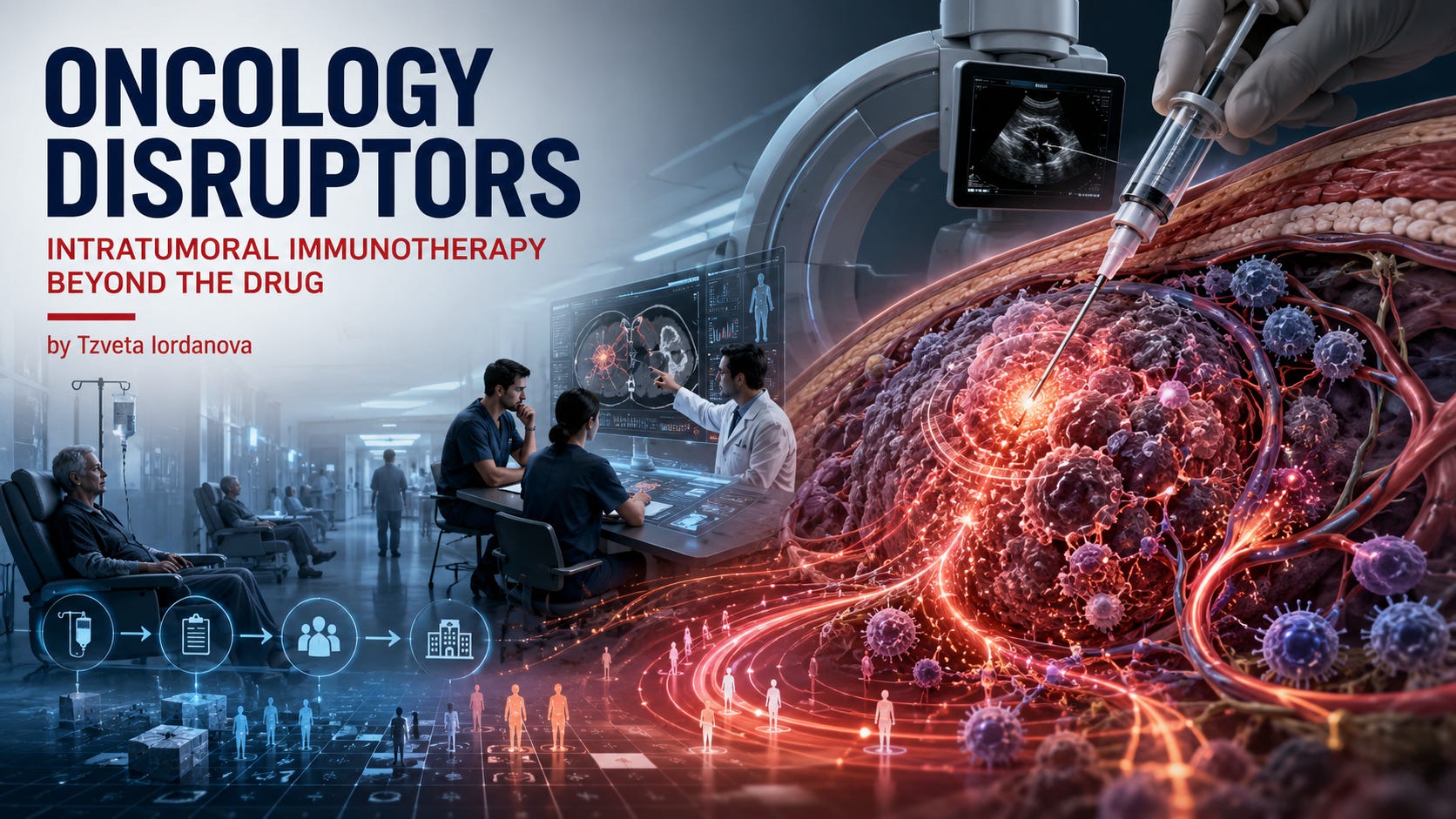
The problem: innovation outpacing evaluation
Oncology innovation is moving faster than the systems designed to evaluate it. New therapies are still tested, approved, and delivered through clinical, regulatory, and economic frameworks that have evolved far more slowly than the science itself.
When novel approaches struggle to validate under these conditions, this does not necessarily reflect failure of the biology. More often, it reflects a system not yet fully designed to test what these strategies actually change and deliver.
Intratumoral immunotherapy brings this mismatch into focus. Instead of adding another systemic agent, these approaches change where, when, and how immune modulation is applied, exposing limits of frameworks optimized for isolated agents rather than access-dependent, procedure-mediated strategies.
From product innovation to system disruption
Oncology trials have long been optimized around a narrow question: does a specific agent work? Intratumoral immunotherapy reframes that question entirely, asking whether disease trajectory can be altered by reprogramming the tumor–immune ecosystem through access, timing, and sequencing.
Where traditional oncology innovation is product-centric - discovering molecules, validating targets, delivering systemically, and escalating on failure - intratumoral immunotherapy operates on a different logic. It begins with tumor access, focuses on local microenvironmental change, engages the immune system at the source, and seeks to preserve systemic capacity.
These are not incremental adjustments in concept, even if their implementation remains constrained by existing systems.
Positioning within innovation frameworks
In practice, intratumoral immunotherapy today coexists with systemic therapy, relies on existing drugs and institutions, is evaluated through legacy drug-like endpoints, lacks broad reimbursement and infrastructure redesign, and is often tested in late-line settings that obscure orchestration value. Adoption remains uneven and niche.
And yet, disruption is already underway. These approaches are beginning to reshape workflows around access-first delivery, introducing immune-aware and multi-modal metrics, elevating procedural immuno-oncology as a core capability, and shifting value from isolated molecules toward strategy and delivery.
They can become truly radical if local-first care becomes the default, systemic therapy becomes conditional, regulatory models evolve to approve strategies rather than drugs, hospitals reorganize around access and orchestration, and training pipelines adapt accordingly.
At that point, intratumoral immunotherapy would not just disrupt oncology - it would redefine it.
How the disruption unfolds
1) Clinical workflow: toward treat-at-access
What breaks: The assumption that diagnosis and biopsy must be separated from treatment by weeks or months through fragmented specialty handoffs, reflecting an infusion-era model in which therapy begins only after staging and onboarding.
What replaces it: Integrated workflows linking imaging, access planning, local delivery, and monitoring, supporting the development of treat-at-access models where diagnosis, sampling, local intervention, and immune priming occur within a single coordinated window (not necessarily the same day).
Why it matters: Waiting periods compress, biologically vulnerable gaps between diagnosis and treatment shrink, and tumor access itself becomes a therapeutic opportunity.
2) Care timing: from late rescue to orchestration
What breaks: Stepwise escalation that treats timing as a scheduling artifact rather than a biological variable.
What replaces it: Orchestration strategies that deliberately sequence local modulation and systemic therapy to shape immune dynamics.
Why it matters: Timing becomes part of the intervention, because late-line trials may understate value when immune education is timing-sensitive.
3) Delivery model: targeted concentration with systemic potential
What breaks: The assumption that efficacy requires whole-body drug exposure.
What replaces it: Localized delivery that achieves high tumor-site concentration with reduced systemic exposure, altered toxicity constraints, and in situ vaccination with possible system effects.
Why it matters: Combination strategies can be built around local intensity and systemic sparing rather than systemic maximum tolerability ceilings that limit what can be combined.
4) Capabilities, infrastructure, and team structure
What breaks: The traditional separation between oncology, surgery, interventional care, and immunology, reinforced by fragmented infrastructure and sequential specialist handoffs.
What replaces it: Hybrid teams and integrated platforms combining image-guided access, immunobiology, tissue handling, immune and longitudinal monitoring.
Why it matters: Execution and orchestration - not just drugs - become the differentiators and shift oncology toward a systems discipline.
5) Surgery and local procedures: from removal to orchestration
What breaks: The framing of local therapy as cytoreduction alone, with procedures treated as independent of immune strategy.
What replaces it: Strategic use of local intervention to shape immune biology in coordination with systemic therapy, extending existing surgical strategy by explicitly incorporating immune modulation as a primary objective.
Why it matters: Local therapy shifts from reducing burden to changing biology, potentially increasing systemic leverage and durability when paired appropriately.
6) Value creation: from molecules to strategies
What breaks: Value defined by ownership of a chronically dosed systemic molecule.
What replaces it: Value concentrates in strategies that control access, delivery, sequencing, and monitoring, shifting differentiation toward platforms and care logic rather than isolated agents.
Why it matters: This suggests a potential shift in where competitive advantage may ultimately accrue - from ‘best drug wins’ toward ‘best strategy wins’ - with implications for reimbursement and the economics of immunotherapy.
7) Hospital economics and incentives
What breaks: Current hospital care pathways and revenue structures are largely optimized around infusion throughput, recurring visits, prolonged treatment cycles, and management of systemic toxicity.
What replaces it: Intratumoral and access-based strategies may favor care pathways with fewer infusions and systemic side effects, shorter waiting windows, and greater reliance on procedure- and coordination-intensive workflows.
Why it matters: Even if clinical outcomes are comparable, shifts in where time, labor, and reimbursement pressure accumulate could require institutional adaptation and may create adoption friction independent of biological performance.
8) Metrics and endpoints: beyond scan response
What breaks: The reliance on stepwise escalation and static imaging shrinkage as the primary indicators of success.
What replaces it: Strategy-level evaluation and expanded endpoint frameworks that pair imaging with longitudinal, lesion-specific, and immune-aware measurements over time.
Why it matters: These measurements begin to support earlier biological insight and adaptive strategy design, creating a pathway toward intervention that responds to immune dynamics rather than waiting for late-stage failure after immune exhaustion.
Patient experience: where the value shows up first
For many patients, the impact of intratumoral and access-based strategies is felt early - not as a breakthrough moment, but as a different experience of care from the start. When tumors are accessible and immune conditions are favorable, care can unfold differently from the start.
In those settings, patients may experience:
Earlier, more intentional intervention, with diagnosis, sampling, and initial treatment more tightly coordinated - reducing prolonged waiting periods and potentially contributing to earlier biological control in selected contexts.
Biology-driven decision-making, where patients understand why a local procedure is performed, how it contributes to immune modulation, and which biological signals are being monitored over time.
Reduced systemic exposure in some regimens, translating into fewer or more localized side effects compared with fully systemic therapy and expanding tolerability for combination approaches.
More targeted, access-based interventions, which in certain settings may be less invasive than extensive surgery, enabling faster recovery and earlier return to daily activities.
Strategic rather than reactive treatment courses, replacing trial-and-error escalation with a coherent plan that integrates local and systemic therapy from the outset.
Less aggressive treatment trajectories in selected cases, where local modulation and immune priming may delay, reduce, or avoid the need for high-intensity systemic or surgical interventions.
These shifts do not promise uniform benefit or guaranteed outcomes. Instead, they reflect care that can feel more purposeful, more coherent, and better aligned with biology and timing.
Conclusion
Intratumoral immunotherapy exposes a recurring tension in oncology innovation. Approaches that reorganize access, delivery, and coordination may generate meaningful biological effects, yet struggle within evidence models designed for systemic agents and discrete products.
The challenge is not simply proving efficacy, but developing validation frameworks capable of assessing system-level strategies. Until those frameworks mature, translation of intratumoral - and similar - approaches will likely remain slower and more fragile than their scientific rationale alone would predict.