
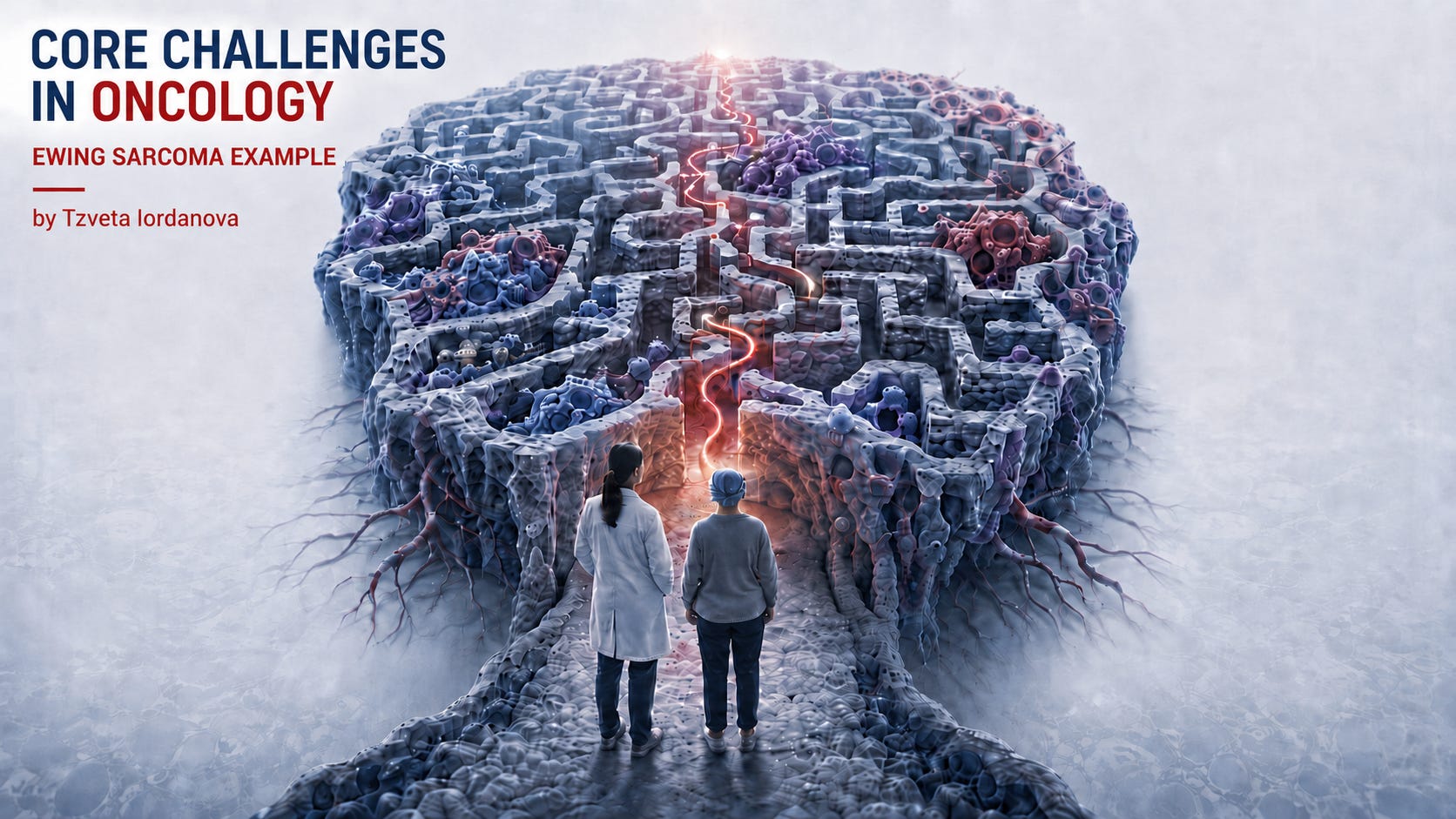
Oncology has a “toolbox surplus” but a “systems thinking deficit.”
Science increasingly shows cancer behaves like a complex, adaptive biological system (heterogeneous, evolving, shaped by microenvironment + host immunity). But the care and innovation system still behaves as if cancer is a linear, targetable object - and as if diagnosis and local interventions are mostly neutral steps before “real treatment.”
Examples of the mismatch
• We treat a tumor like a static target, yet it behaves like an evolving ecosystem: subclones expand, phenotypes switch, and the microenvironment rewires under pressure.
• We develop “the best drug” for a mutation, while patients fail because the tumor is immune-excluded, hypoxic, or physically inaccessible.
• We generate lots of data (NGS, imaging, biomarkers), but the clinical pathway has limited ability to convert that data into adaptive actions over time.
So we keep optimizing ingredients (drugs) while under-investing in orchestration (strategy, sequencing, local control, immune preservation, adaptive monitoring) - even though outcomes are often determined by the system’s response over time.
What is broken
The oncology system is organized around “variant → drug” logic, while cancer is organized around adaptation, context, and time - creating predictable gaps in standard-of-care (SOC).
Examples of “variant → drug” blind spots
• Biomarker says “PD-L1 low” → “not a candidate,” despite mixed tumor regions where invasive margins may be immunologically active.
• Biomarker says “PD-1/PD-L1 high” → “a candidate,” but microbiome composition (e.g., low beneficial bacteria Akkermansia muciniphila and others) blocks immune response.
• Mutation says “targetable” → therapy given, but drug cannot penetrate the stroma/hypoxia and never achieves effective exposure.
• A response is achieved → everyone relaxes, but resistant clones are being selected in parallel.
Why the current model predictably underperforms
1. Cancer is multi-pathway and redundant
Single agents can shrink tumors, but the system re-routes (feedback loops, clonal selection, phenotypic switching). Durable control requires anticipating adaptation, not reacting to resistance.
2. Microenvironment governs whether drugs can work
Access, hypoxia, stroma, immune exclusion, metabolic constraints - these determine if therapies reach targets and if immune responses can be mounted.
3. Strategy beats ingredients
Same modalities can produce radically different outcomes depending on sequencing, timing, delivery route, and immune-state management.
4. Diagnosis and local care are not biologically neutral
Imaging radiation, biopsy trauma, inflammation, wound-healing programs, immune perturbation - these can shift host-tumor dynamics. Yet SOC rarely designs countermeasures or tracks biologic “cost.”
The system-level gaps
• Static decisions instead of closed-loop adaptation.
• Siloed modalities without an orchestration layer.
• Sparse real-time monitoring of host integrity (immune competence, inflammatory state) despite its role in metastasis control.
• Combinations exist, but are validated as static recipes, not dynamically evaluated for immune compatibility, sequencing effects, or cumulative biologic harm.
• Guideline bias toward precedent rather than biological reality - what’s measurable and standardized wins over what’s causally important.
How this shows up in Ewing Sarcoma
Ewing Sarcoma makes the mismatch obvious because:
• The primary driver (EWS-FLI1) is effectively “undruggable,” so drug-centric logic stalls at the center of the disease.
• The disease is highly metastatic and immune/microenvironment sensitive, so host integrity and timing matter.
• SOC is multimodal and intense - yet often tracks toxicity crudely while missing key biology (lymphocyte dynamics, immune suppression patterns, inflammatory cascades).
Ewing is not just hard because the tumor is aggressive; it is hard because the system lacks an orchestration layer that treats diagnosis + local control + immune preservation as part of the therapy.
The “real” problem statement
We are fighting an adaptive biological system with a care model optimized for isolated interventions.
This creates SOC vulnerabilities where:
• we trigger biology (biopsy, radiation, delay) without countermeasures,
• we stack modalities without system-level immune stewardship, and
• we measure tumor response more than we measure the host’s capacity to prevent relapse and metastasis.
The opportunity
The next wave of oncology innovation is less about a single breakthrough drug and more about:
• orchestrating existing modalities,
• local-first and microenvironment-enabling strategies, and
• closed-loop, real-time adaptation that treats host integrity as a first-class clinical endpoint.
A strong “north star”
Build oncology for the system cancer actually is - adaptive, contextual, time-dependent - by shifting from product optimization to strategy orchestration.